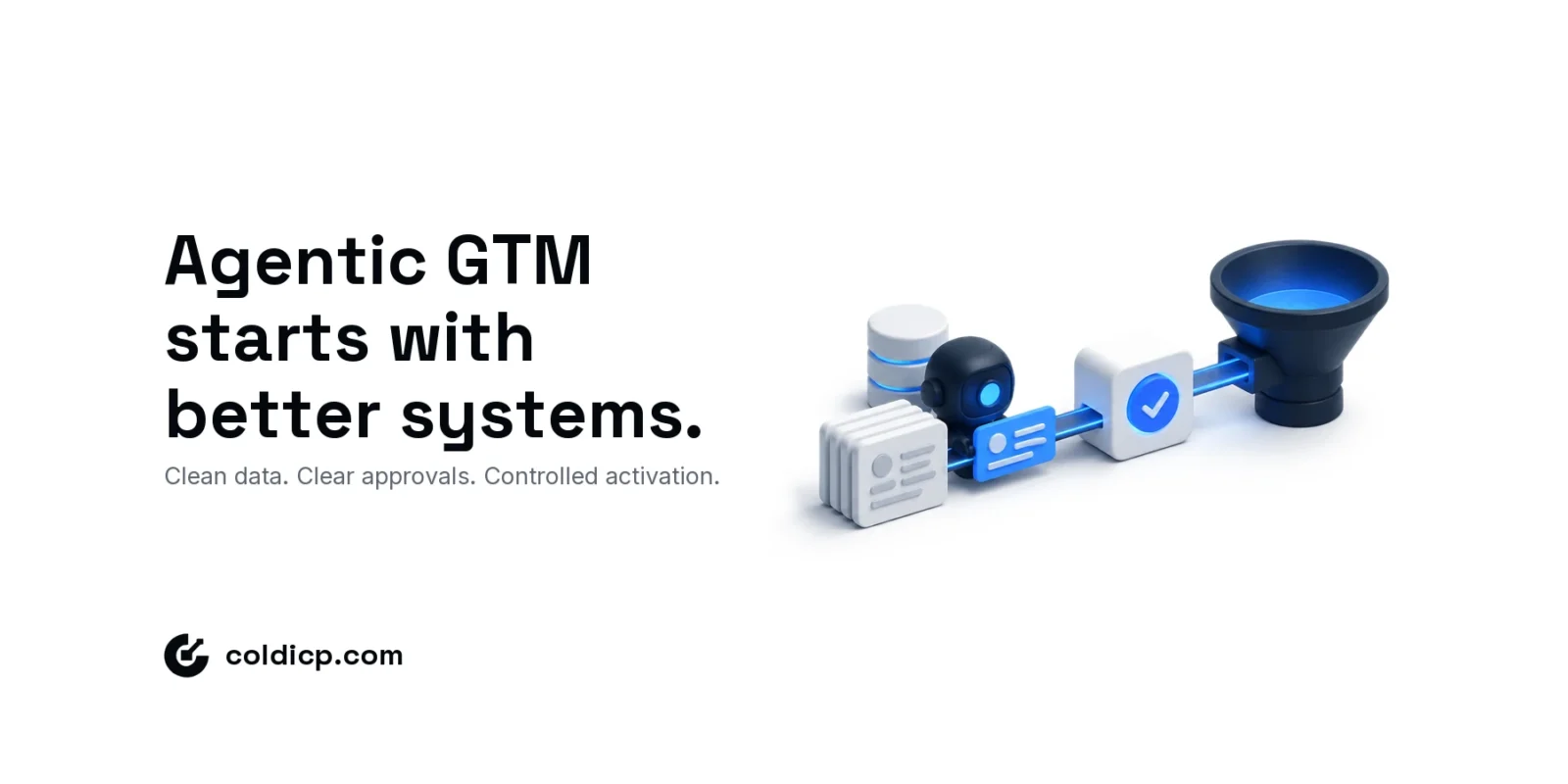
Agentic GTM is a go-to-market system where AI agents do multi-step revenue work: researching accounts, weighing buying signals, enriching records and preparing the next message, then handing the decision to a person or another system. It is not a self-driving revenue engine. The teams getting value give each agent one narrow job, reliable data, limited permissions and an outcome they can measure.
Agentic GTM is not about sending more messages; it is about making better revenue decisions inside a controlled system.
What is agentic GTM?
Anthropic’s guide to building effective agents draws a useful line. Workflows run language models and tools through predefined code paths. Agents direct their own process and tool use to reach a goal. Both count as agentic systems, and the guide recommends the simplest option that does the job.
In GTM terms, a workflow says “when a form is submitted, add the contact to a sequence.” A GTM agent gets a goal instead: review this account, decide whether it fits the ICP, find the strongest current buying signal, judge whether outreach makes sense and explain why. The difference is not whether AI is involved but how much judgment the system is allowed to apply.
Take one trigger, a target account hiring a new VP of Sales, and compare how each handles it:
| Step | Rules-based workflow | GTM agent |
|---|---|---|
| Input | CRM title field changes | Job post, company site, CRM record |
| Decision | Title is VP Sales, so enroll | In the ICP? Why now? Who else to involve? |
| Output | Contact added to a sequence | Brief plus a recommended next step |
| Failure mode | Wrong people enrolled at scale | Confident but wrong brief |
| Control | Enrollment rules | Review queue and audit log |
That flexibility pays off when inputs are messy and the right next step depends on what the agent finds. It also raises the stakes on strategy, data and controls, because a badly designed agent repeats a bad decision across thousands of records.
How an agentic workflow runs end to end

A practical system has six layers, each with a clear input, output, owner and failure condition.
| Layer | Agent responsibility | Control required |
|---|---|---|
| Research | Collect information on the account, people, technology and events | Approved sources and a freshness rule |
| Qualification | Compare the account with the ICP and explain the fit | Defined scoring criteria and review samples |
| Enrichment | Fill missing company, contact and signal fields | Provider waterfall and a verification gate |
| Prioritization | Rank accounts by fit, timing and confidence | Human review for ambiguous records |
| Activation | Draft or route the next message or task | Suppression rules and sending limits |
| Learning | Summarize outcomes and recommend changes | Outcome definitions and an audit log |
You can build this with a CRM, enrichment tools, a sending platform and an agent runtime such as Grok Bot or Claude Code; our Grok Bot vs Claude Code comparison shows how to choose one. Brand names matter less than handoffs. If enrichment output does not map cleanly into the CRM, or the sending system cannot enforce the agent’s limits, the workflow is not ready to scale.
What AI agents are good at in B2B GTM
Agents earn their keep on repeated research, structured comparison and tasks with a clear decision boundary: scanning company pages for a specific change, summarizing a hiring pattern, comparing a tech stack with your target profile, or preparing a brief for a seller.
- Account research: turning scattered public information into a consistent brief.
- Signal detection: spotting hiring, funding, leadership changes or technology adoption.
- Data operations: finding missing fields, flagging conflicts and routing records through enrichment providers.
- Message preparation: linking a relevant observation to an approved offer and drafting a message for review.
- Operational monitoring: reporting failed jobs, stale data, unusual volume and workflow changes.
These are leverage points, not permission slips. An agent can recommend that an account fits; that does not mean it should enter a campaign automatically. Relevance, confidence and the outreach rules that apply still decide that. For how far this goes in replacing people, see our AI SDRs vs human SDRs reality check.
What agents cannot fix
AI agents cannot make up for an undefined ICP. They can write a convincing explanation of why a record looks interesting, but a commercially meaningful definition of fit comes from your market, offer, sales process and evidence about which customers succeed.
They also cannot make bad data reliable by writing fluent prose around it. If a record is stale, duplicated or attached to the wrong person, the agent produces a polished but false recommendation. That is why B2B data enrichment needs verification, scoring and a refresh cycle, not a one-time export.
And no agent can guarantee inbox placement. More automated research can mean more volume, and more volume magnifies list and reputation problems. Keep authentication, list quality and monitoring grounded in the email deliverability checklist rather than in the agent’s assumptions.
The data layer comes first
An agent is only as useful as the data it can inspect. Before adding autonomy, define the account model and required fields: industry, size, geography, technology, relevant contacts, source dates, qualification score, signal type, signal date and suppression status.
Use a waterfall when no single provider covers enough records. Start with the cheapest adequate source, pass only unresolved records to the next, verify the result and stop when the record meets your acceptance rule. That cuts duplicate spend and makes the agent’s reasoning easier to check.
Keep “unknown” separate from “no.” A missing hiring signal is not proof a company is not hiring, and a missing email is not proof a contact has none. Agents need uncertainty stored in the data, not hidden behind a default value.
Design permissions before autonomy
Start read-only. Let the agent produce a report, recommendation or draft while a person reviews it. Once you know its error rate and useful-output rate, grant one narrow action at a time.
- Read: inspect approved sources and records.
- Recommend: produce a score, explanation or next-step suggestion.
- Draft: prepare a message or CRM update for approval.
- Execute: perform a reversible, low-risk action.
- Scale: expand only after the workflow has a measured baseline.
Keep irreversible or high-impact actions behind human approval. No agent should be able to raise a sending cap, clear suppression records, replace a domain, overwrite a CRM field or launch a campaign because a prompt told it to optimize pipeline.
The practical next step is to assign authority by task; this AI sales agents control model separates suggestion, approval and bounded execution.
Agentic GTM and deliverability
AI GTM agents change deliverability in two directions. They can make targeting more relevant by using current signals instead of blasting every record, and they can raise the speed and volume of outreach, which raises the cost of a bad decision.
Put an enforced dispatch gate outside the agent: approved daily volume, mailbox ownership, suppression rules, bounce thresholds and an incident owner. Monitor by mailbox and domain, not only by campaign. If placement falls or hard bounces rise, pause, preserve logs, diagnose and resume only with owner approval. The deliverability monitoring runbook for AI agents gives example triggers for each signal.
A simple test: compare what the agent can change with what you can audit. If it can change more than you can see, the system is under-controlled.
A practical starting point
Do not start by building an agent that “runs GTM.” Pick one narrow job with a measurable output. A good first workflow finds companies hiring for a role that strongly correlates with your offer, writes a short evidence-backed brief and routes qualified accounts to a review queue.
Run it on a fixed sample. Review every recommendation, measure precision, log false positives and note where the agent lacked information. Then improve the source order, scoring rule, prompt or approval step. Only once the output is dependable should the workflow write to the CRM or prepare campaign-ready records.
This is where a GTM engineering system earns its value: it turns a promising AI capability into a maintained process with ownership, integrations, monitoring and documentation.
The Bottom Line
Agentic GTM makes B2B sales and marketing more responsive by connecting research, signals, data operations and next-step decisions. The goal is not maximum autonomy but reliable leverage: agents handle repetitive investigation and preparation while people keep strategy, judgment and high-impact actions.
COLDICP has taken 22+ clients from email infrastructure setup to campaign live. If you need the data and outbound layer designed underneath your agents, apply for the GTM Pilot.
FAQ
What does agentic GTM mean?
A go-to-market approach where AI agents use tools and context to carry out multi-step research, qualification, enrichment and operational tasks, with people approving high-impact actions.
Is agentic GTM the same as AI automation?
No. Automation follows fixed rules on predefined paths. An agent interprets information and chooses among next steps, though its permissions should still be tightly limited.
What is the best first use case for GTM agents?
A narrow, measurable, read-only job such as account research, signal detection or data-quality reporting. Avoid starting with autonomous campaign sending.
Do AI agents replace GTM engineers?
No. They increase the need for people who define data models, integrate tools, set permissions, monitor outcomes and maintain the system.