Cold outreach automation is the controlled use of software and AI to move prospects from targeting through research, messaging, follow-up and CRM updates. It should remove repetitive work without removing judgment. The safest design automates defined transformations, records every handoff and requires human approval before an uncertain decision becomes an external action.
Automate the repeatable work; keep judgment, exceptions and irreversible actions with an accountable owner.
What cold outreach automation actually includes
A sending sequence is only one part of the system. Useful automation starts with a market definition, creates qualified records, verifies contact data, prepares relevant context, controls dispatch, routes replies and writes outcomes back to the CRM. If one stage is disconnected, the team saves clicks but inherits reconciliation work.
That is why a scalable B2B outbound system needs explicit inputs and outputs. A prospect should never enter a campaign merely because an email address exists. It should enter because the account matches the ICP, the contact owns the problem, the address passed verification and the campaign has capacity.
| Stage | Automated work | Failure signal | Human control |
|---|---|---|---|
| Targeting | Apply approved fit rules | Too many borderline accounts | Approve the ICP and exclusions |
| Sourcing | Collect account and contact records | Missing source or stale date | Approve providers and coverage |
| Verification | Check addresses and required fields | Risky or conflicting result | Define acceptance rules |
| Research | Prepare evidence for personalization | No source supports the claim | Review samples and exceptions |
| Sending | Sequence approved records | Volume, bounce or complaint alert | Own caps and pause decisions |
| Replies | Classify and route responses | Low-confidence classification | Handle ambiguity and escalation |
| CRM | Write normalized outcomes | Duplicate or invalid state | Own the data model |
Map cold outreach automation before choosing tools
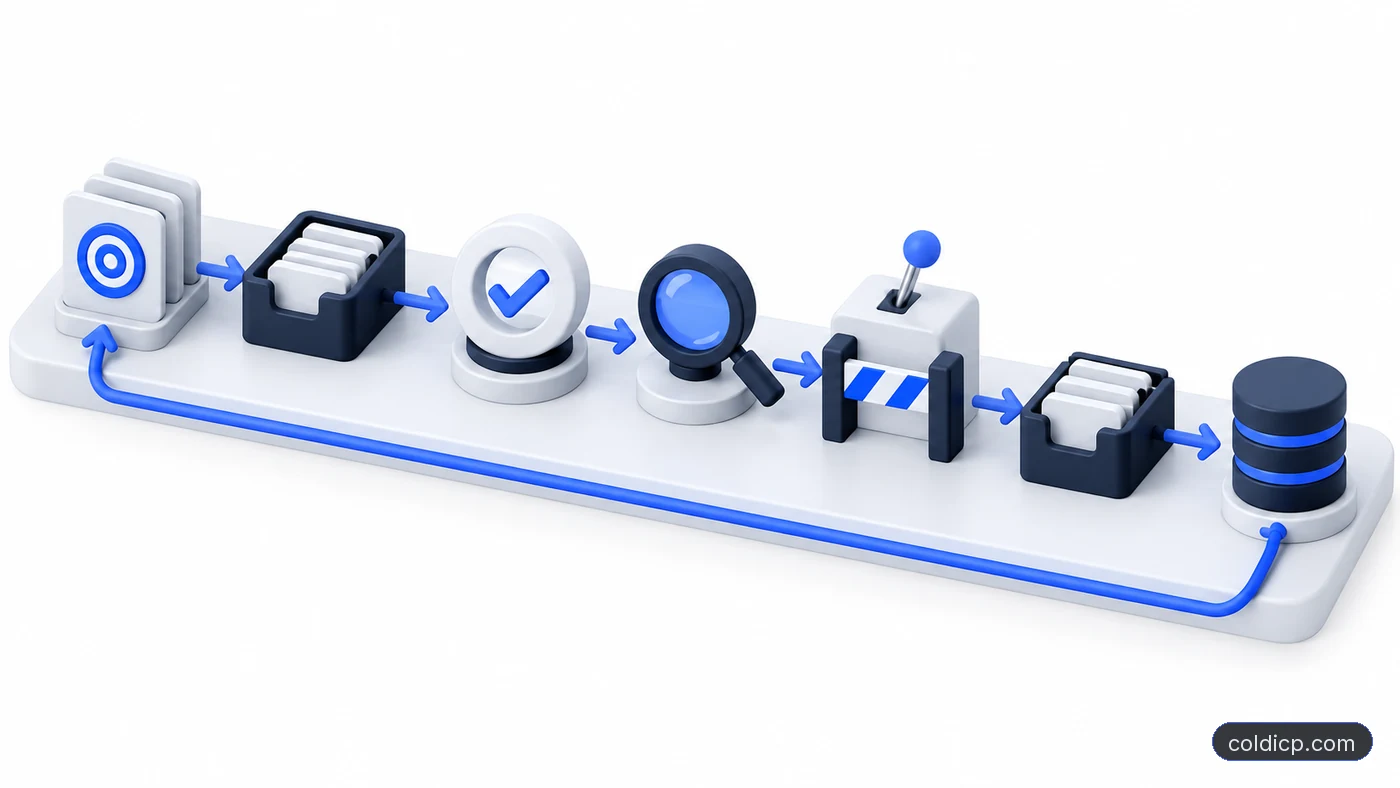
Begin with the workflow on paper. For each step, name the source, required fields, acceptance rule, destination and owner. Then mark whether a failure can be reversed. That exercise separates simple workflow automation from decisions that need context.
For example, normalizing a company domain is deterministic. Deciding that a funding announcement makes an account ready for outreach is judgment. The first can run automatically when validation passes. The second should produce a recommendation with evidence until the team measures its precision.
The four-layer outbound tech stack is a useful reference, but architecture comes before product names. Otherwise teams buy overlapping databases, let several tools overwrite the same field and discover that no system owns suppression or campaign state. When the sending platform itself is the open question, work through how to choose a cold emailing tool before signing anything.
Cold outreach automation by stage
A practical implementation starts upstream. Define the TAM and ICP, source accounts, enrich only the fields required for a decision and verify the contact route. Sourcing and enrichment are an API job — BlitzAPI, Clay and similar platforms search, enrich and validate company and people records — while final-hop address validation is a separate purchase from MillionVerifier, ZeroBounce or Bouncer. Waterfall enrichment and mailbox-level verification answer different questions, and treating them as one is how bounce rates climb. Research should return evidence rather than confident prose. Personalization should use approved claims and offers. Sequencing should accept only campaign-ready records.
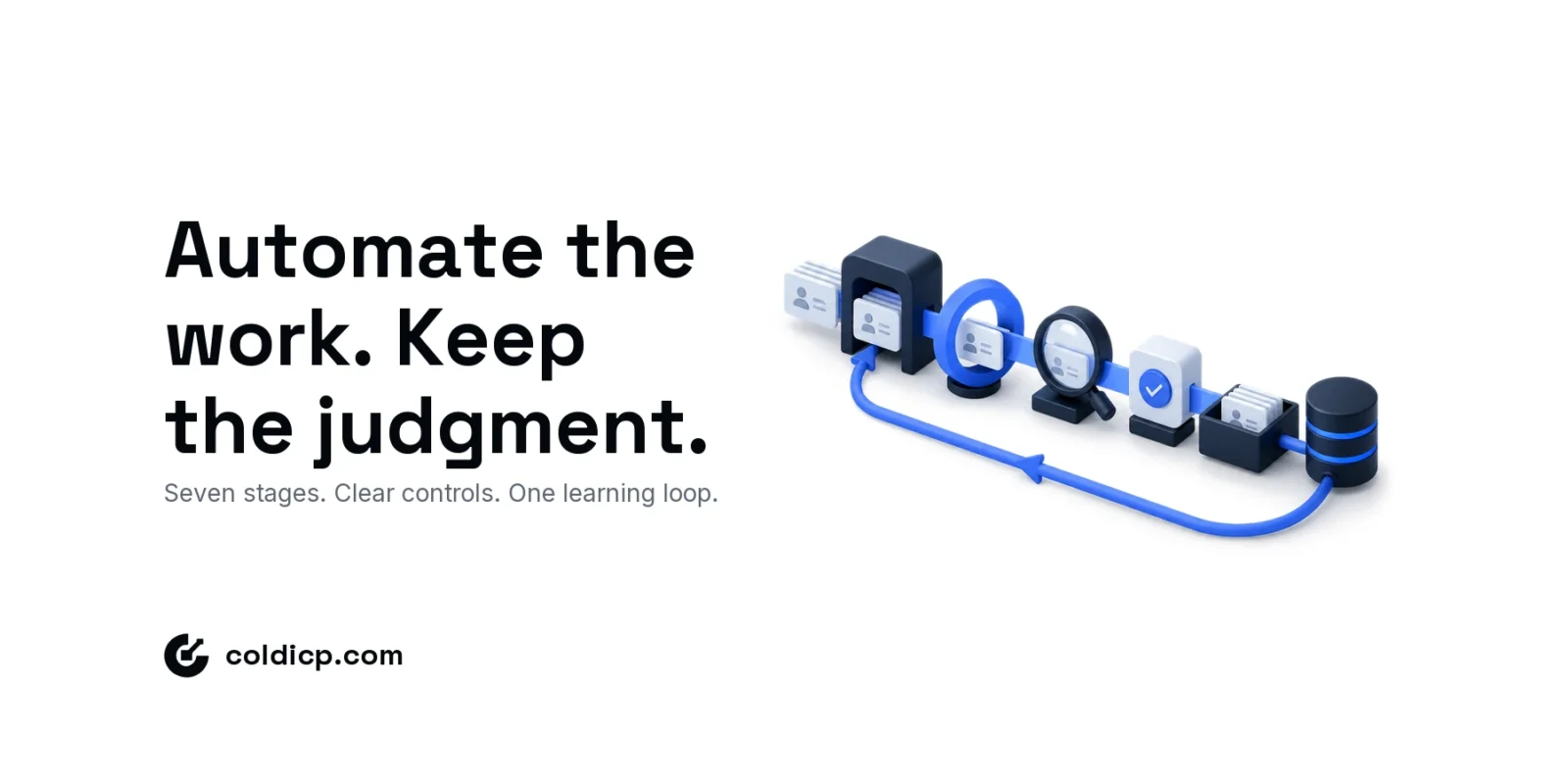
Then connect the downstream loop. Positive replies become owned opportunities, objections become structured feedback, bounces become data-quality events and unsubscribes become global suppression. Without that loop, cold outreach automation increases activity while the system learns nothing.
- Define: document fit, exclusions and the outcome the campaign is meant to create.
- Prepare: source, enrich and verify records without enrolling them.
- Review: inspect a fixed sample and record false positives.
- Activate: send within mailbox and domain limits.
- Learn: write outcomes back and revise one rule at a time.
Keep consequential decisions behind approval
Approval is most valuable where an error is public, expensive or hard to reverse. People should approve offer changes, new audience definitions, disputed qualification, mailbox replacement, daily-volume increases and the first use of a new data source.
An agent can prepare those decisions. The Agentic GTM guide explains why a narrow job and limited permissions outperform a vague instruction to run GTM. The same principle applies here: read and recommend first, draft second, execute only after the output is stable. The three control levels for AI sales agents set out which jobs earn which authority.
Approval must show the current value, proposed change, evidence and expected effect. A button labeled approve is not a control if the reviewer cannot see what will happen.
Protect data quality and deliverability
Automation magnifies input quality. A stale title becomes a wrong message; an unverified address becomes a bounce; a missing suppression record becomes an avoidable complaint. Store the source and observed date beside material fields so the system can distinguish unknown data from a negative answer.
Dispatch controls should live outside the agent or campaign prompt. Enforce daily limits, approved mailboxes, suppression rules and pause thresholds in the sending layer. Google’s sender guidance says spam rates should stay below 0.1% and never reach 0.3%; its sender-guidelines FAQ also points teams to Postmaster Tools for monitoring.
Use the email deliverability monitoring framework to assign alert owners and recovery steps. More automation should make abnormal behavior easier to stop, not merely easier to create.
Connect replies and CRM state
A reply classifier can separate positive interest, referral, objection, unsubscribe and out-of-office messages, but low-confidence cases need a queue. The classifier should never silently discard a reply or invent a pipeline stage.
Suppression is also a legal obligation, not only a reputation control: the FTC’s CAN-SPAM compliance guide requires opt-out requests to be honoured within 10 business days. Automate that path first, because a missed unsubscribe is the one failure that cannot be corrected after the fact.
Make the CRM the durable system of record. Store campaign membership, last meaningful response, owner, next action and suppression state in normalized fields. If the sending platform and CRM disagree, define which one wins for each field rather than choosing whichever updated last.
This is where revenue operations and outreach meet: automation becomes dependable when valid states are designed, ownership is visible and exceptions have a route.
Roll out cold outreach automation in phases
Start with one campaign and one bounded workflow. A useful pilot takes an approved account list, verifies the required fields, prepares evidence-backed research and stops at a review queue. Measure accepted records, rejected records, false positives, processing cost and operator review time.
Next, allow the system to prepare campaign-ready rows. Only after the team trusts that output should it enroll records automatically, and even then sending limits and suppression remain outside the workflow. The 30-day outbound setup provides a sensible sequence for infrastructure, data, campaigns and review.
A pilot succeeds when it creates reliable output with less handling, not when it touches the most tools. If errors scale at the same rate as volume, the design is not ready.
The Bottom Line
Cold outreach automation can reduce research, routing and administrative work, but it cannot replace a clear market, verified data or accountable decisions. Design the full loop, automate reversible work first and give every failure an owner.
If you need the targeting, infrastructure and controls built as one maintained system, review COLDICP’s B2B outbound agency approach and apply for the GTM Pilot.
FAQ
What is cold outreach automation?
It is a connected system that automates repeatable targeting, data, research, sequencing, reply-routing and CRM tasks while preserving approval for risky decisions.
Which outreach tasks should not be fully automated?
Keep audience strategy, offer changes, ambiguous qualification, volume increases and other consequential actions under an accountable human owner.
Does cold outreach automation hurt deliverability?
It can if it raises volume without verification and enforced limits. Good automation makes suppression, authentication, monitoring and pause rules mandatory.
What is the best first automation?
Start with a read-only preparation workflow that verifies records and returns a review queue. Measure its errors before granting campaign access.