Most teams do not build a B2B outbound system. They assemble one accidentally — a list here, a sequencing tool there, a rep asked to make it work — and then wonder why output does not scale with effort. A system is different from a campaign in one specific way: adding volume to a system produces proportionally more pipeline, and adding volume to a campaign mostly produces more complaints.
This is the build order, the decisions at each stage, and the checks that tell you a stage is finished before you move on.
What Makes a B2B Outbound System, Not a Campaign
Three properties, and you need all three:
- Repeatable — the same inputs produce the same outputs without a specific person present
- Instrumented — when output drops, you can identify which stage caused it
- Improvable — each cycle produces information that changes the next one
A B2B outbound system has all three; a campaign can hit a number once and explain none of it. Only a system tells you why it hit, which is the difference between a good quarter and a repeatable one. Everything below exists to produce those three properties.
A system also needs a clear automation boundary: this guide to cold outreach automation maps which handoffs can run automatically and which decisions still need an owner.
Stage 1: Define the Segment as a Query
The first deliverable is not a persona document. It is an executable filter that returns a count: headcount band, funding stage, technologies present, and the specific role you sell to. If that filter returns 300 accounts, outbound is the wrong motion and you should be running account-based selling instead — finding that out on day one rather than in month four is most of the value of doing this properly.
Done when: you can state the filter in one sentence, run it, and get a number between roughly 1,000 and 50,000 accounts.
Stage 2: Build the Sending Infrastructure
A campaign can hit a number once. Only a system tells you why it hit.
Start this second because it has a hard four-to-six week lead time that nothing compresses. Register three to five sending domains, put a mailbox provider on each, publish SPF, DKIM and DMARC per Google’s sender guidelines, configure reply forwarding, and start warmup immediately.
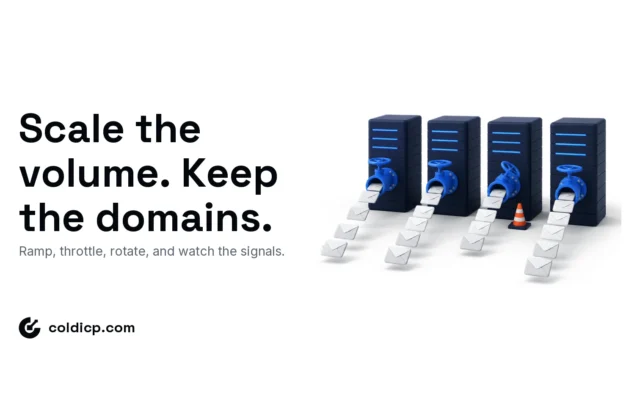
Never send outbound from your primary domain — a complaint wave takes your transactional and marketing email down with the campaign. As volume grows, domain protection at scale covers the rotation and monitoring that keeps a single bad week from ending the programme.
Done when: warmup has run four weeks, a test send scores 9+ on a placement check, and every domain authenticates cleanly.
Stage 3: Build the Data Pipeline
Turning the Stage 1 filter into contact records with the attributes you need to write to them. Enrichment waterfalls keep this affordable: cheapest source first, fall through only on a miss. Verify every address before it enters a sequence and hold hard bounces under 2%.
Verification tooling and blacklist checks such as MXToolbox belong in this stage, not after the first bad week. The part teams skip is refresh. B2B contact data decays at roughly 25–30% a year through job changes alone, so a list built once is a list that degrades from the day it is built. Our note on list and data decay covers the refresh cadence.
Done when: you can regenerate the list from the filter without manual work, and bounce rate on a test batch is under 2%.
Stage 4: Add the Signal Layer
Signal is what separates a system that sends to everyone from one that sends to the right accounts at the right time. Funding rounds, executive hires, technology changes and hiring surges all indicate the budget or authority to act has just moved. Job-change signals are the highest-yield, because a new executive is explicitly evaluating vendors in their first ninety days.
The operational metric here is time from signal to first touch. Most teams never measure it and are surprised to find it runs three to six weeks, by which point the trigger is cold.
Stage 5: Write and Structure the Sequence
| Timing | Job | Length | |
|---|---|---|---|
| 1 | Day 0 | One specific observation, one ask | Under 100 words |
| 2 | Day 3–4 | Different angle, not a reminder | Under 80 words |
| 3 | Day 8–10 | Proof — a result, a comparable | Under 100 words |
| 4 | Day 15–18 | Resource with no ask | Under 60 words |
| 5+ | — | Diminishing returns, rising complaints | Do not send |
Three to four emails is the working range, and published sales benchmarks broadly agree on the shape even where the specific numbers differ. The second email being a genuinely different angle rather than “just bumping this” is the single highest-leverage change most sequences need. Adding LinkedIn touchpoints alongside email lifts reply rates when the timing is coordinated, and dilutes them when it is not.
Stage 6: Instrument It
week 0   segment defined as a query          count: 8,400 accounts
week 0   domains registered, DNS published   5 domains
week 1-6 warmup running                      cannot be compressed
week 2   data pipeline built                 bounce rate  touch < 7 days
week 6   first send                          200-500 /domain/day
week 10  first qualified meetings            ← 30-60 days from launch
Four numbers decide what you change next: inbox placement, positive reply rate, meeting-to-opportunity rate, and time from signal to first touch. Open rate belongs on none of them — privacy features inflate it to the point of uselessness.
The diagnostic logic is strict about order. If placement moved, nothing else in the funnel is interpretable, because the population that received the email is not the one you think. Fix placement, re-measure, then read the rest.
What a Working B2B Outbound System Looks Like
A system at steady state on five domains sends roughly 1,000–2,500 emails a day, produces a 5–15% total reply rate with 2–8% positive, and delivers first qualified meetings 30–60 days after launch. Full optimisation — proven variants, coverage at scale — takes 90–120 days. Our pipeline growth case study walks one build end to end.
Further Reading
The 30-day outbound setup plan
Structuring a multichannel sequence
Signal-led outbound, explained
The Bottom Line
Build a B2B outbound system in dependency order, not in the order things feel urgent. Segment as a query, infrastructure second because of its lead time, then data, signal, sequence, and instrumentation last. Each stage has a completion check, and moving on before that check passes is how teams end up with a campaign that cannot be debugged.
The most common sequencing error is writing copy first, because copy is the enjoyable part. Copy written before infrastructure exists gets judged on results that were never about the copy, which teaches the team something false and expensive. If you would rather have the system built and operated for you, book a meeting.
FAQ
How long does it take to build a B2B outbound system?
Six to eight weeks to first send, dominated by the four-to-six week domain warmup that runs in parallel with everything else. First qualified meetings land 30–60 days after launch. Anyone promising sends in week one is skipping warmup, and you will pay for it in placement.
Can a small team run this?
Yes — one person can operate a system covering several thousand accounts once it is built, which is the point of building it. What a small team cannot absorb is the build and the operation simultaneously, so the usual failure is starting the build and abandoning it mid-way when a quarter gets busy.
How many sending domains do I actually need?
Three to five for most programmes, more only as volume demands, at 200–500 sends per domain per day. The number is set by your target volume divided by that ceiling, not by ambition — extra domains do not increase capacity if the list underneath them is not big enough to fill them.
What breaks first when scaling?
Deliverability, almost always, and usually because volume rose faster than domain count. The second most common is list quality, when the filter gets loosened to fill capacity and reply rates fall in step with the relevance you gave away.